Architecture
How the pieces fit together, and the decisions that are settled.
The pieces
You talk to a commander. It dispatches soldiers, each in its own camp, and a sentinel wakes it when one settles.
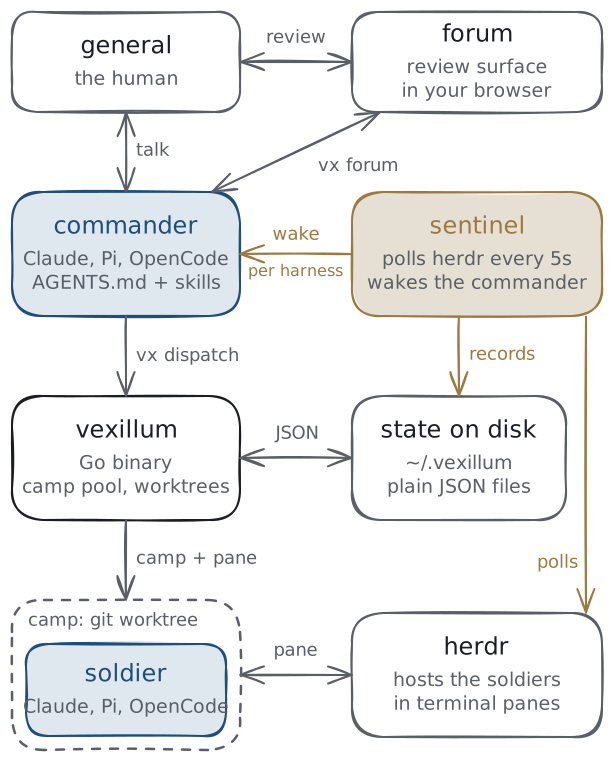
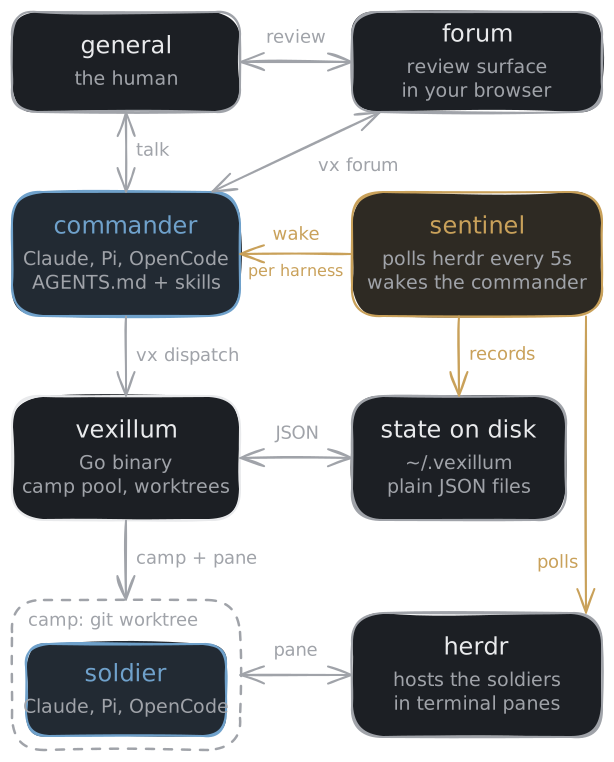
- You talk to the commander, a Claude Code session (or Pi or OpenCode, see Pi as the commander and OpenCode as the commander) steered by
AGENTS.mdand skills. It opens artifacts for you in the forum and reads your feedback from there. - The commander runs
vx dispatch. The vexillum binary keeps its state on disk, acquires a camp and starts a soldier in a herdr pane. - The sentinel polls herdr every 5 seconds, records each outcome in the state and wakes the commander. A Claude Code commander is woken by the
Stophook, a Pi commander by a wake extension that runs inside Pi, and an OpenCode commander by the sentinel posting the wake into its session through OpenCode's API (see Sentinel).
Decisions that are settled
- Go, shipped as a binary by Homebrew and curl, with no runtime dependencies.
- Claude Code is the default harness for the commander and for every soldier. A model profile can run its soldiers on Pi or OpenCode instead; the binary reaches all of them through one
Harnessinterface. - herdr hosts the panes the soldiers run in.
- Intelligence is markdown, not Go. The binary does deterministic plumbing; routing and judgment live in the AGENTS.md core and the skills.
- Domain vocabulary stays in English (commander, soldier, mission, scout, camp, sentinel) in every language.
- One commander. You always talk to a single commander.
Safety model
| Layer | Guarantee |
|---|---|
| camp | commits and working tree are isolated from yours |
land | fast-forward only; refuses a dirty checkout or a diverged branch; never forces |
strike | refuses while the camp has uncommitted or unlanded work |
ship | pushes only after every tribunal step passes, deterministically |
redispatch, strike --discard | the only operations that discard a camp, so the commander asks first |
The process itself is not sandboxed. See the warning on the introduction.